
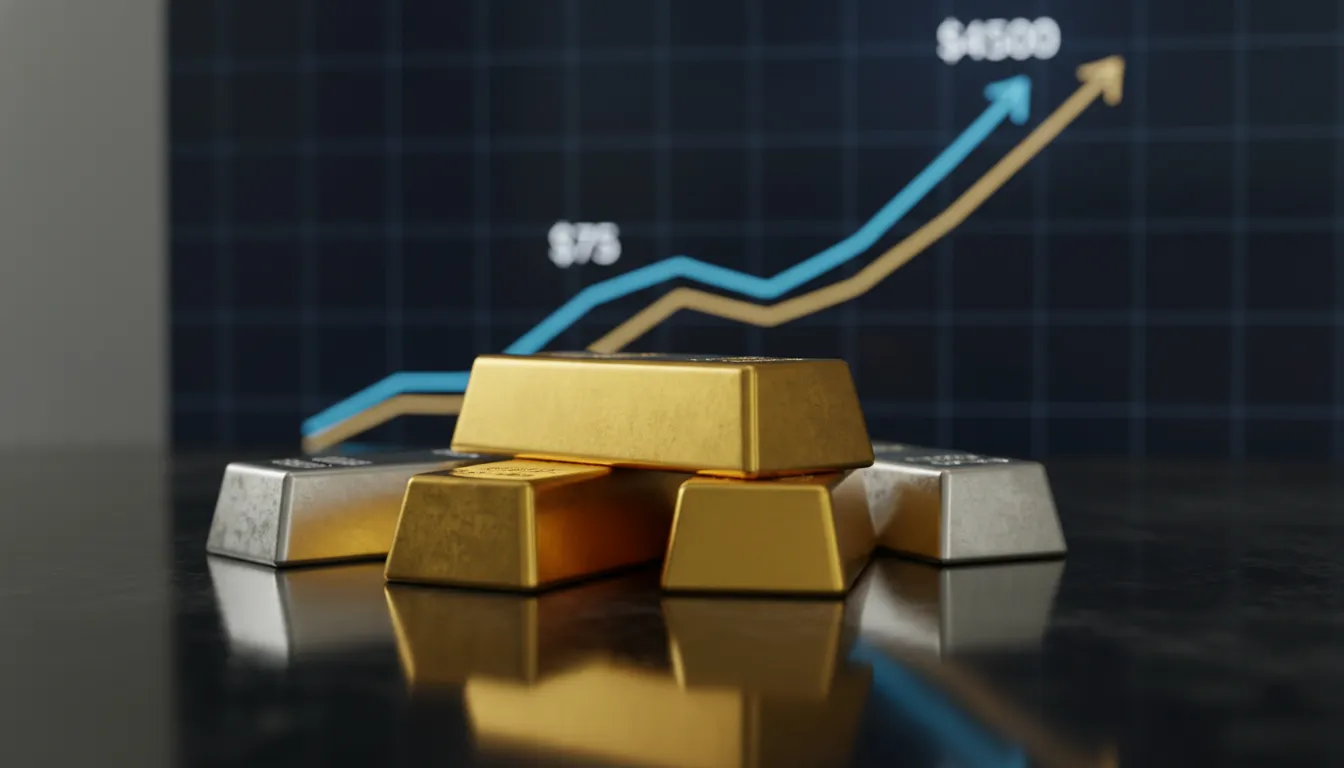
Market Alert: Gold Breaches $4,500, Silver Eclipses $75 in Historic Valuation Shift
Date: December 27, 2025
Market Focus: Commodities & US Futures
Analyst Note: Critical breakout levels confirmed.
In a watershed moment for global commodities markets, gold and silver futures have shattered psychological and technical resistance levels, closing at record highs of $4,500 and $75 per ounce, respectively. This unprecedented price action signals a fundamental decoupling from traditional valuation models, driven by a confluence of aggressive Federal Reserve easing, deepening geopolitical fractures in South America and Eastern Europe, and a systemic rotation out of overleveraged equity sectors. For US investors, this is not merely a price spike; it represents a structural re-rating of hard assets against a weakening dollar.
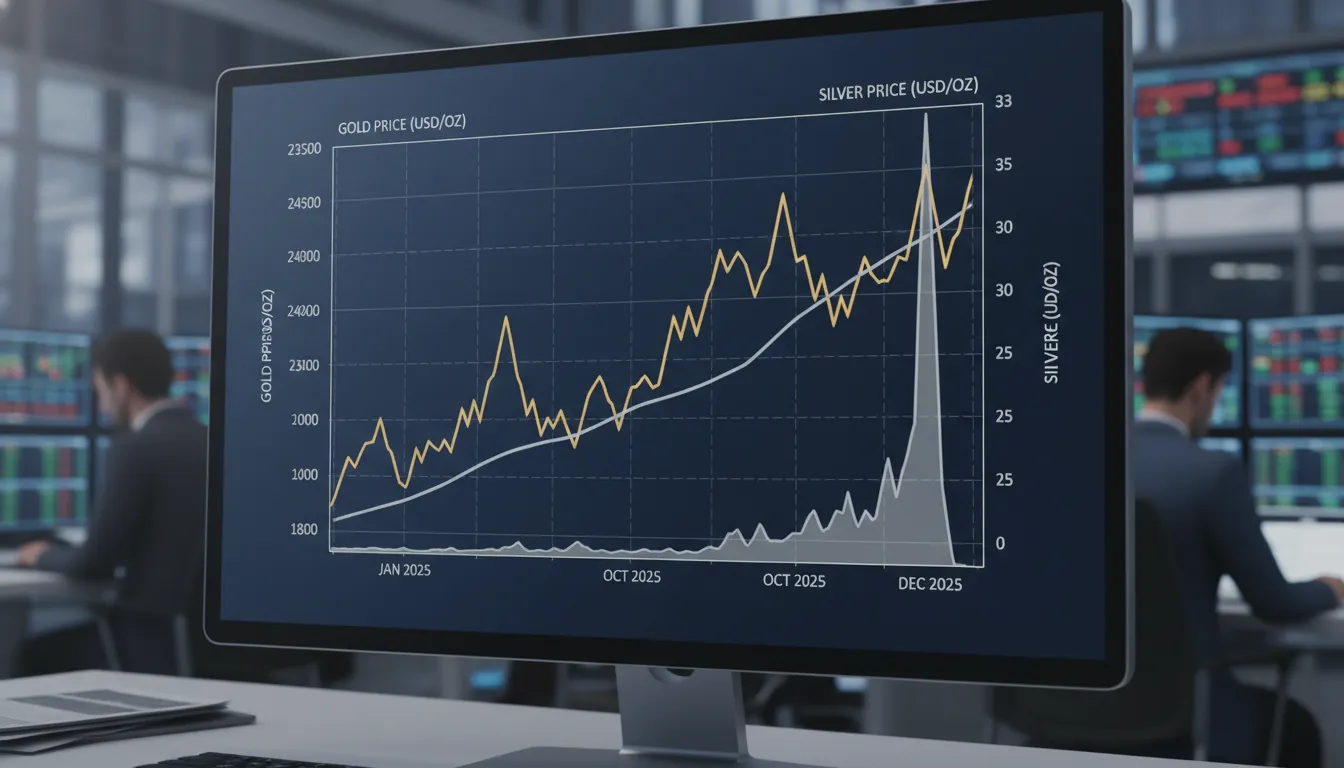
The Macro-Drivers: Why $4,500 and Why Now?
The ascent to $4,500 gold is not speculative mania but a rational market response to the deterioration of real yields. With the Federal Reserve cutting rates by 75 basis points this year despite persistent core inflation hovering above 3%, real interest rates have plunged deeper into negative territory. Institutional capital is fleeing the erosion of purchasing power in Treasuries for the sovereign neutrality of bullion.
1. The “Fed Pivot” Reality
The Federal Reserve’s pivot to accommodate liquidity concerns has effectively capped nominal yields, while inflation expectations remain unanchored. In this environment, the opportunity cost of holding non-yielding assets like gold has evaporated. The market is pricing in two additional rate cuts for Q1 2026, providing a sustained tailwind for precious metals.
2. Geopolitical Risk Premium
The current administration’s quarantine of Venezuelan oil exports and the escalating tensions in the Strait of Hormuz have revived stagflationary fears reminiscent of the late 1970s. Unlike previous rallies driven by fear alone, this move is supported by central bank accumulation. The People’s Bank of China (PBoC) and other BRICS nations have accelerated their de-dollarization efforts, establishing a “soft floor” for gold prices near $4,200.
Silver at $75: The Industrial Supercycle
While gold’s rally is monetary, silver’s surge to $75 is structurally driven by a chronic supply-demand deficit. Silver has outperformed gold significantly in Q4 2025, driven by its dual role as a monetary metal and a critical industrial component.
- Green Energy Demand: The US critical minerals list update earlier this year, which emphasized silver’s role in next-generation solar photovoltaics and EV solid-state batteries, has triggered panic buying among industrial end-users.
- Inventory Depletion: COMEX and London Vault inventories are at multi-decade lows. The “just-in-time” delivery model for industrial silver has fractured, forcing manufacturers to stockpile physical metal at any price.
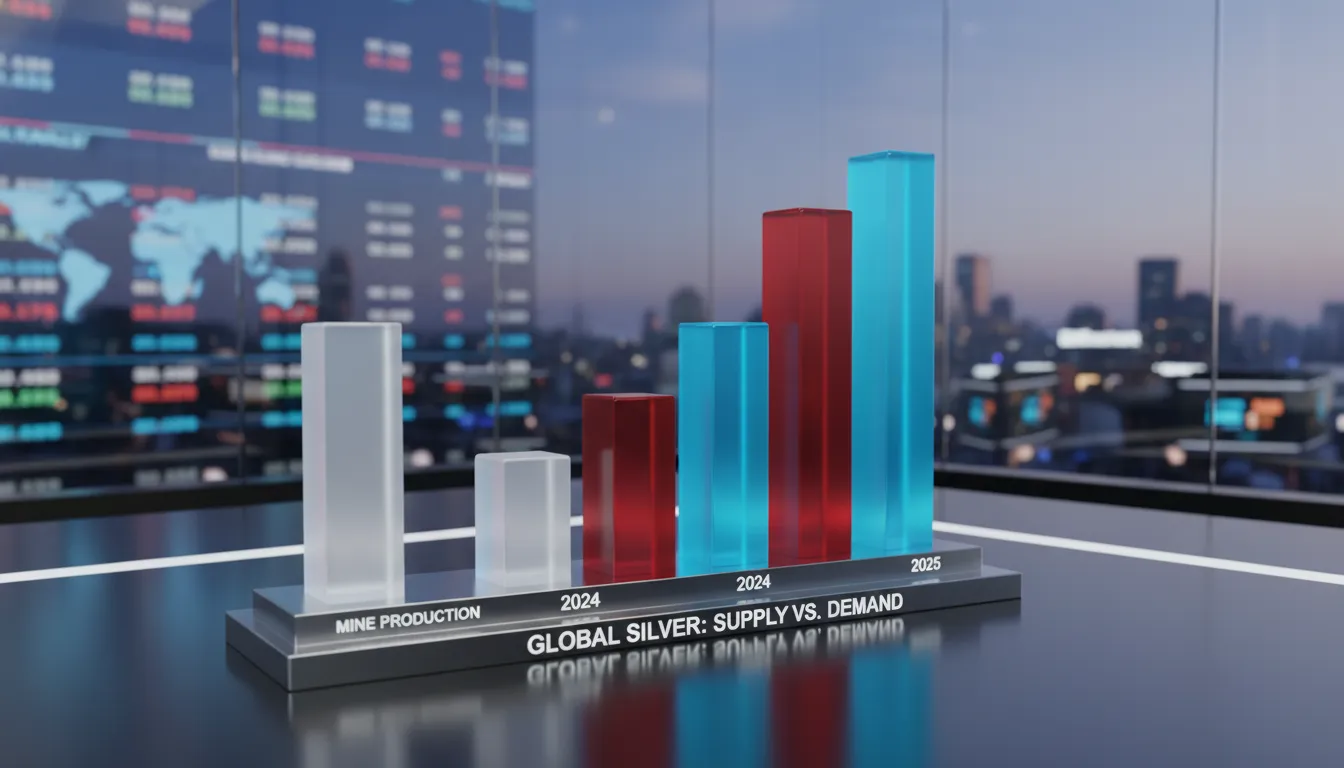
Comparative Market Data: Gold vs. Silver
The following table outlines the key performance metrics and driver divergence between the two metals as of the close of markets this week.
| Metric | Gold Futures (GC) | Silver Futures (SI) |
|---|---|---|
| Current Price | $4,502.80 / oz | $75.14 / oz |
| YTD Performance | +72% | +158% |
| Primary Driver | Monetary Debasement / Central Bank Buying | Industrial Deficit / Green Tech Demand |
| Key Support Level | $4,430 | $68.50 |
| Gold/Silver Ratio | ~60:1 (Historically Low) | N/A |
Implications for the US Market
The Wealth Effect and Consumer Sentiment
For the average US consumer, these prices signal rising input costs. Silver is ubiquitous in electronics and medical devices; a sustained price above $70 will inevitably pass through to consumer prices, complicating the Fed’s inflation fight. Conversely, for portfolios with a 5-10% allocation to commodities, this rally has served as a vital hedge against the underperformance of the S&P 500 in real terms.
Regulatory and Tax Considerations
Investors must navigate the tax landscape carefully. The IRS continues to classify precious metals as “collectibles,” subjecting long-term gains to a maximum tax rate of 28%, significantly higher than the standard 20% capital gains rate for equities. This distinction becomes material when liquidating positions that have appreciated by over 100% in a single calendar year.
Frequently Asked Questions (FAQ)
1. Is it too late to enter the market at these levels?
While the parabolic move suggests a short-term consolidation is likely (a “breather” for prices), the fundamental drivers—negative real rates and industrial shortages—remain intact. Analysts suggest “buying the dip” rather than chasing the breakout.
2. How does the US “Critical Minerals” designation affect Silver?
The inclusion of silver on the critical minerals list allows for potential government subsidies for domestic mining projects and strategic stockpiling. This adds a layer of demand that is price-inelastic, effectively removing supply from the commercial market.
3. Can I take physical delivery of these futures contracts?
Yes, COMEX contracts allow for physical delivery. However, premiums on physical coins and bars have widened. At $75 spot, retail investors are often paying upwards of $85-$90 per ounce for physical silver eagles due to minting bottlenecks.
Final Outlook: The Path to $5,000 and $100
The breach of $4,500 gold and $75 silver marks the end of the “consolidation era” and the beginning of a new price discovery phase. The psychological target of $5,000 gold is now within striking distance for Q1 2026, contingent on the Federal Reserve maintaining its dovish stance.
For silver, the path to $100 is less dependent on the Fed and more on physical scarcity. If industrial users begin to bypass the futures market to secure direct offtake agreements with miners, the price mechanism could become disorderly to the upside. US investors should remain overweight in hard assets but vigilant for volatility as profit-taking bouts occur.