

Global Silver Crisis: Record Prices & Imminent China Export Controls Threaten U.S. Industry
Date: December 29, 2025
Market Alert: Critical Supply Chain Disruption Warning
The global industrial sector is facing a “perfect storm” as silver prices breach historical ceilings, trading near $79 per ounce, while markets brace for China’s restrictive new export licensing regime taking effect on January 1, 2026. With only days remaining before the world’s largest silver refiner tightens its grip on global supply, U.S. industries ranging from photovoltaics (solar) to electric vehicles (EVs) are confronting an unprecedented supply shock. This report analyzes the structural deficit driving this rally and the specific implications for American manufacturing.

The “January 1” Catalyst: China’s Export Licensing Regime
While silver prices have been in a structural uptrend throughout 2025 due to widening supply deficits, the immediate catalyst for the current volatility is Beijing’s new export control policy. Effective January 1, 2026, China—which controls approximately 60-70% of global refined silver capacity—will implement a rigorous export licensing system.
Unlike a blanket ban, this policy is a “soft restriction” designed to consolidate state control. To qualify for an export license, firms must meet stringent criteria:
- Minimum Production Volume: Exporters must produce at least 80 tonnes of refined silver annually.
- Financial Thresholds: Firms require verified credit lines exceeding $30 million.
Analyst Insight: This regulatory moat effectively disqualifies hundreds of small-to-mid-sized Chinese refiners and traders who historically supplied the spot market. The result is an immediate contraction in global liquidity, forcing international buyers to compete for a smaller pool of available metal from state-approved entities.
U.S. Industrial Exposure: The “Unsubstitutable” Input
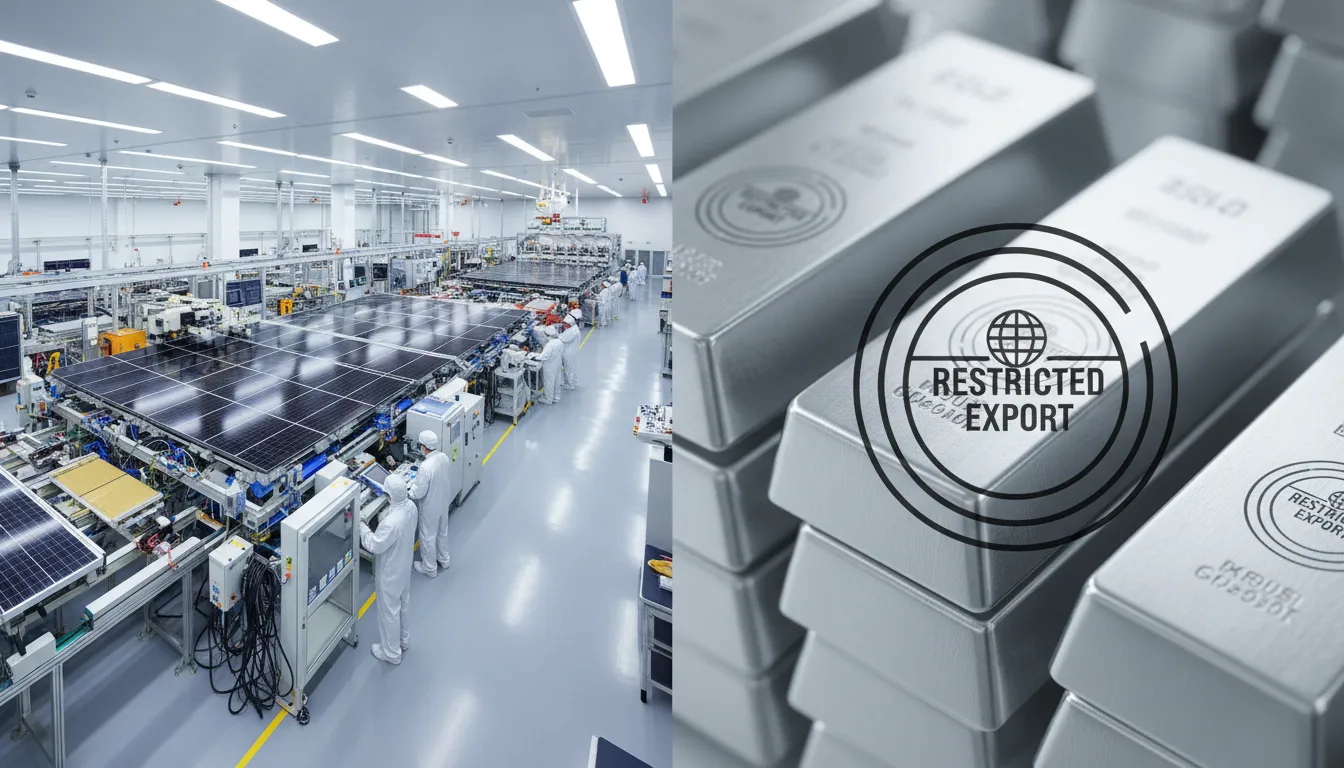
The timing of these restrictions is particularly damaging for U.S. industrial policy, which relies heavily on silver-intensive green energy technologies. Unlike gold, which is primarily a monetary asset, over 55% of annual silver supply is consumed by industrial applications. For many of these uses, silver is non-substitutable due to its unique conductivity.
1. Solar Photovoltaics (PV)
The U.S. solar sector is the most exposed. Modern TOPCon and HJT solar cells require significantly more silver per watt than older PERC technologies. With the Inflation Reduction Act (IRA) driving domestic solar manufacturing, U.S. demand has hit record highs just as supply chains are fracturing.
2. Electric Vehicles (EVs) & Electronics
An average EV uses approximately 25-50 grams of silver—nearly double that of an internal combustion engine vehicle. Tesla CEO Elon Musk recently highlighted this vulnerability, stating on X (formerly Twitter), “This is not good. Silver is needed in many industrial processes,” in response to the surging input costs.
Data Analysis: The Widening Structural Deficit
The price explosion is not merely speculative; it is grounded in a physical shortage that has been building for five years. The table below outlines the deteriorating supply-demand balance.
| Metric | 2024 (Actual) | 2025 (Est.) | YoY Change |
|---|---|---|---|
| Global Demand | 1.19 Billion oz | 1.24 Billion oz | +4.2% |
| Total Supply (Mine + Scrap) | 1.00 Billion oz | 1.01 Billion oz | +1.0% |
| Market Deficit | -190 Million oz | -230 Million oz | +21% (Deficit Widens) |
| Average Price (Dec) | ~$30.00 / oz | ~$76.50 / oz | +155% |
Note: The “Market Deficit” represents the gap between physical use and supply. This gap has historically been filled by above-ground stockpiles, which are now critically depleted in London and New York vaults.
Strategic Implications for U.S. Stakeholders
The “Paper vs. Physical” Disconnect
A dangerous divergence has emerged between the “paper” price of silver (futures contracts traded on COMEX) and the physical price. With premiums on physical delivery exploding, industrial buyers are paying significantly above spot prices to secure inventory. This suggests that the futures market may be losing its ability to set the price, as physical scarcity forces direct bilateral negotiations between miners and end-users.
Inflationary Pressure
While silver is a fractional cost in a smartphone, it is a material cost driver for solar panels and specialized electronics. Manufacturers will face a difficult choice in Q1 2026: absorb the 150%+ cost increase or pass it on to consumers. Given the thin margins in solar manufacturing, price hikes for finished panels are almost certain.
FAQ: Regulatory and Market Concerns
Will the U.S. government intervene to secure silver supplies?
The U.S. Department of Commerce is currently investigating whether reliance on imported critical minerals constitutes a national security risk. While strategic stockpiling is discussed, the U.S. lacks a significant national silver reserve, limiting immediate intervention options.
Can U.S. domestic mining fill the gap?
No. The U.S. produces less than 4% of the global silver supply. Silver mining is capital-intensive and has long lead times (10+ years from discovery to production). Domestic output cannot ramp up fast enough to offset a disruption from China.
Does this affect consumer electronics prices?
For small devices like phones, the impact is negligible per unit. However, for “big ticket” items like EVs and home solar installations, the cumulative cost of silver (now hundreds of dollars per vehicle) will contribute to “greenflation”—rising costs for green energy transition goods.
Final Outlook: The New Normal for 2026
As we cross into 2026, the era of cheap, abundant industrial silver is effectively over. The convergence of China’s resource nationalism and a chronic structural deficit has fundamentally repriced the metal. For U.S. investors, silver has re-emerged as a high-beta strategic asset. For U.S. industry, however, the focus must shift immediately from “just-in-time” inventory management to “just-in-case” strategic stockpiling. The volatility witnessed in December 2025 is likely just the opening act of a prolonged supply squeeze.